A Courtyard Where the Forest Teaches
Every afternoon after school, Adivasi children in Panna and Vidisha gather at a Bal Angan — not a tuition class, but a place where a leaf can teach arithmetic and a grandmother's story can teach history.
Two Districts, Two Tribes, One Pattern
Bal Angan didn't start as an education idea.
It started as a response to what dispossession from land was doing to children.
“Our approach is not to replace government efforts but to strengthen them — helping marginalised children claim their constitutional right to education, health and social protection.”
Panna — the Gond, and the emerald mines
In Panna's emerald-mining belt — villages like Kaimasan, Baror, Madayan and Darera — Gond families have been pushed off the land and forest they once depended on. With that livelihood gone, many end up in unregulated mine labour, and children follow their parents into it or into seasonal migration for brick-making and stone-cutting.
Vidisha — the Sahariya, and the quarries
In Ganj Basoda, the Sahariya — officially a Particularly Vulnerable Tribal Group — face landlessness, informal labour in stone quarries, and health crises like tuberculosis and silicosis from that same quarry work. Poverty here isn't a phase; for many families, it's structural.
What Actually Happens After School
A Bal Angan meets daily, led by a young educator from the same community. Class isn't lecture-style — children move between a whole-group opening, small-group work grouped by ability rather than age, and hands-on tasks outdoors.
Children are grouped as beginner, intermediate, or advanced within the same theme, so a child who can't yet read sits alongside older classmates without being singled out — Assigned by ability, not age or grade.
-
Level 1 (Classes 1–2),
-
Level 2 (3–5),
-
Level 3 (6–8)
A session typically opens with something everyone can join — a song, a story, a question — before splitting into levelled tasks, and closes with the whole group reflecting on what they made or found that day.
“If the emotion is strong, reading and writing will come fast.” — from the curriculum framework, on why Level 1 starts with touch and smell before it starts with a pencil


Why We Stopped Teaching From Textbooks
Textbook lessons were losing children — younger siblings tagging along broke concentration, and middle-schoolers found the material repetitive. A nature-based curriculum, built on five themes, replaced it.
-
Biodiversity — counting seeds, measuring leaves, mapping forests.
-
Nutrition & Health — traditional diets, clean water, hygiene.
-
Tribal Culture — folklore, pottery, festivals, oral history.
-
Gender & Equality — shared roles, in nature and at home.
-
Environment — water, land, and the seasons that shape both.
Each theme threads through every subject — a nature walk becomes a maths lesson in counting and a Hindi lesson in new vocabulary in the same hour.
Learning That Starts Outside the Classroom
Saturdays belong to the forest. Children identify birds by call, track animal footprints, test soil, and collect oral histories from elders — the same knowledge their grandparents grew up with, now being written down for the first time.


Learning Doesn't Happen on an Empty Stomach
Every Bal Angan serves a daily meal, grown in large part by women running kitchen gardens in their own villages — many of them widows or single mothers who now supply fresh vegetables to the centre.
The week's menu rotates with the season and what's locally grown — millet and ragi laddoos, boiled chana, khichdi, moong sprouts, and amla candy. Children help prepare it, which doubles as a hands-on nutrition lesson.

Who's Actually in the Room
Every Bal Angan is led by a young person from the same community — often still finishing their own education. Training them is as much a part of the programme as teaching the children.
August 2024 — Three-day teacher workshop, Panna & Vidisha
11 community educators and 2 coordinators worked on leaf identification, non-standard measurement (handspan, foot), clay and craft, and building lesson plans from natural materials.
August 2024 — Ecology education training, Hyderabad
Educators from Panna, Ganj Basoda and Adilabad spent a day on an urban forest walk, learning bird calls and seasonal insect behaviour from naturalist Sharada Ma'am.
February 2025 — Youth theatre workshop & street plays
Village youth wrote and performed nukkad nataks on education, dropout and child labour — then took the plays door to door across five villages.
The Honest Numbers
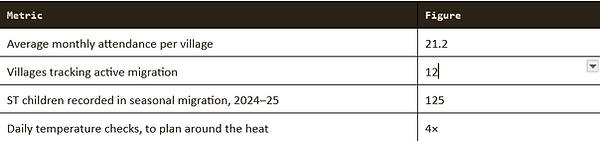
Attendance moves with the seasons, not with interest — families migrate for brick-making, stone-cutting and harvest work for 3–6 months at a stretch, and most take their children with them.
Villages with stronger local support, like Manor and Darera, show attendance nearly double that of villages with heavier migration.